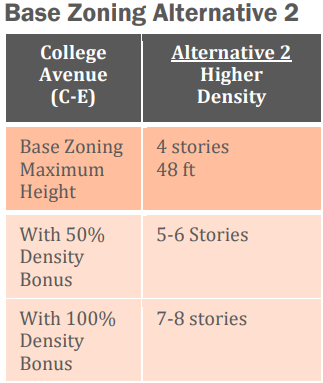
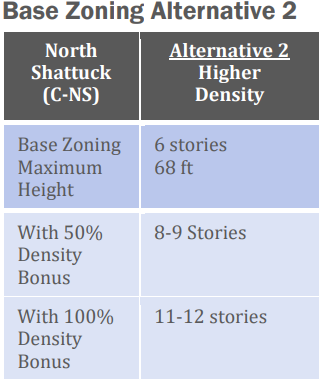
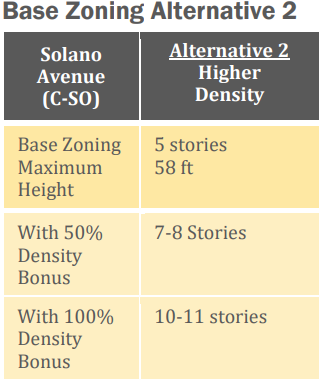
Proposed a plan to allow for 8-12 story high rises on North Shattuck, Solano Ave and College Ave — the Corridors Zoning Upgrade (CZU) — posing a serious threat to the small businesses that so many people prize about Berkeley and are a big part of the city’s economic engine.
Details
Berkeley’s neighborhood shopping districts are a local treasure. The variety of shops, many locally owned, that are present on Solano Ave, College Avenue, and North Shattuck draw not just locals, but also regional shoppers who want to enjoy something different than the chain stores and big box stores available in their cities. The Berkeley neighborhood shopping areas are currently human scale, promoting a sense of community and human interactions.
However, the Berkeley City Council is attempting to pass laws that would destroy these businesses on Solano, College and North Shattuck by allowing 8-12 story high-rise apartment buildings to be built in their place or right next door. They claim there will be ground-floor commercial space in the high-rises, and seem to have an almost religious belief that the old businesses will come back after the buildings they were in have been demolished. Look around at all the new high-rise buildings that have been built in Berkeley. What occupies the commercial spaces present on the ground floors? There answer is all-to-frequently “nothing”, and if there is a commercial tenant, it is rarely anything remotely resembling the businesses that were forced out. They are likely gone forever.
In fact, even some Council members realize that these ground floor “commercial” spaces will never have businesses move in. They have discussed allowing the ground floor spaces to be used for more residential units, essentially admitting that the high-rise building spree is causing a loss of businesses.
Downtown and the areas immediately adjacent have been designated for high-rise buildings. Take a walk downtown and see how that is working out so far. Empty or boarded up storefronts and large holes in the ground where buildings used to be. Fewer stores and less variety of places to go. Art venues that are closing down. And still a lack of genuinely affordable housing.
Let’s work to create a functional downtown, rather than destroy the thriving existing commercial districts on Solano, College, and North Shattuck.
The Berkeley City Council sponsored a number of public workshops to introduce residents to the corridor rezoning plan. Unfortunately, they continued to not take concerns of both businesses and residents seriously, tightly controlling the agenda and promoting misleading versions of the plans.
Proposed unadjusted height limits on buildings presented during public workshops for the CZU were 4 stories for College Ave, 5 stories for Solano Ave, and 6 stories for North Shattuck. Residents were assured that developers would only request the 50% density bonus, giving rise to buildings 6-9 stories tall.
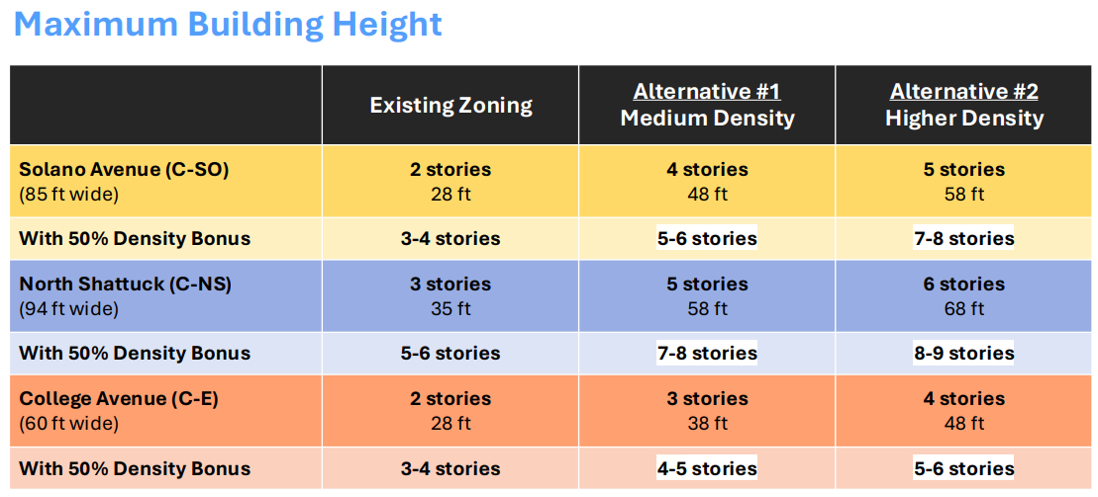
In fact, virtually all references to the density bonus at the workshop assumed this 50% bonus, ignoring the real possibility of builders invoking the 100% density bonus, which would have given rise to buildings 8-12 stories tall. But at the November 6 Council meeting, council members unanimously supported 7 story unadjusted heights on all the corridors, resulting in buildings up to 14 stories tall on College, Solano, and North Shattuck.
During a special Council Meeting on Nov. 6, 2025, Jordan Klein, Director of Planning and Development, stated that no building permit had been granted for a project requesting 100% Density Bonus. He corrected himself only after a member of Build a Better Berkeley spoke up to point out that, in fact, a project on Shattuck had been granted a permit for 100% Density Bonus; and moreover, the developer for a proposal at 2029 University Avenue also had requested 100% Density Bonus.
The apparent deliberate dismissal and underplaying of the 100% density bonus during public meetings is odd, since in the official city document discussing corridor alternatives the possibility is not quite so cavalierly dismissed: