Councilmember Kesarwani and city council limit affordable and family housing at council meeting on September 29, 2026
As part of the SPASP, certain parcels are designated as “Affordable and Family Housing Opportunity Areas”. These parcels are scheduled to be rezoned from multi-use light industrial to residential, significantly increasing their monetary value. To “account for the benefits that come to the property of being zoned as residential”, staff had suggested that either:
In a building of rental units, all be affordable to households earning less than 60% of the Area Median Income (AMI, $87,900 for a family of 3), or
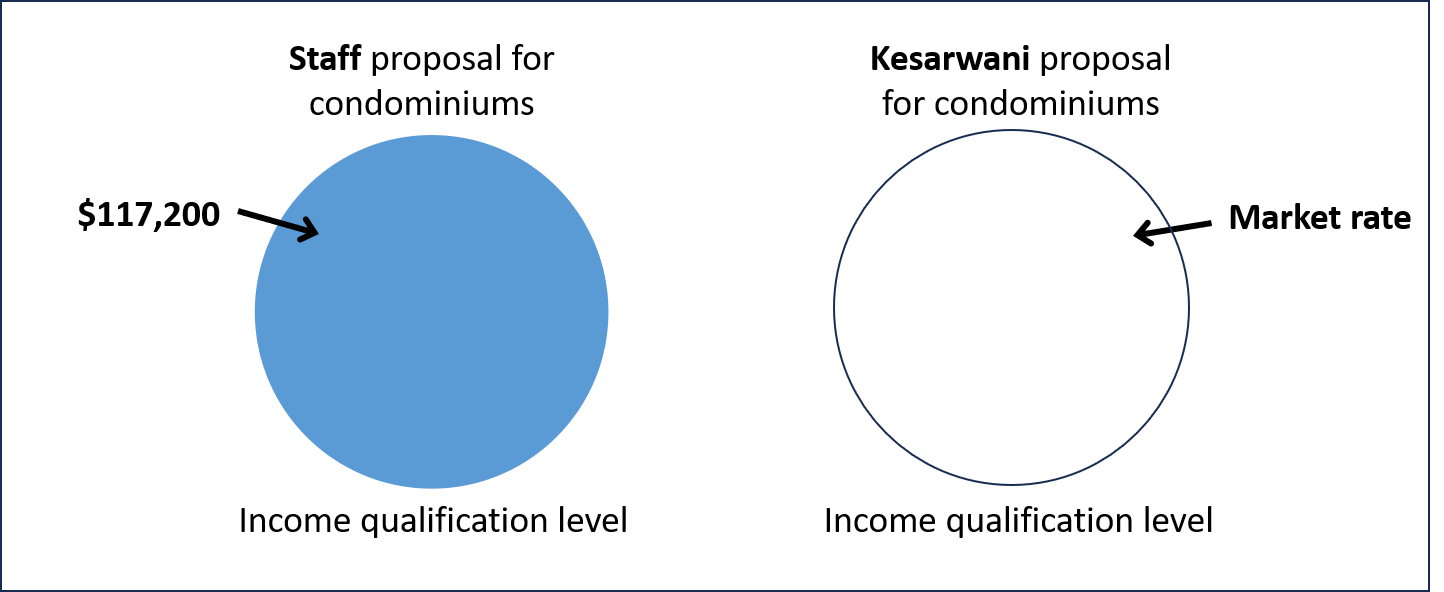
In a condominium building, all the units be sold at a price affordable to households earning less than 80% of AMI ($117,200 for a family of 3), or
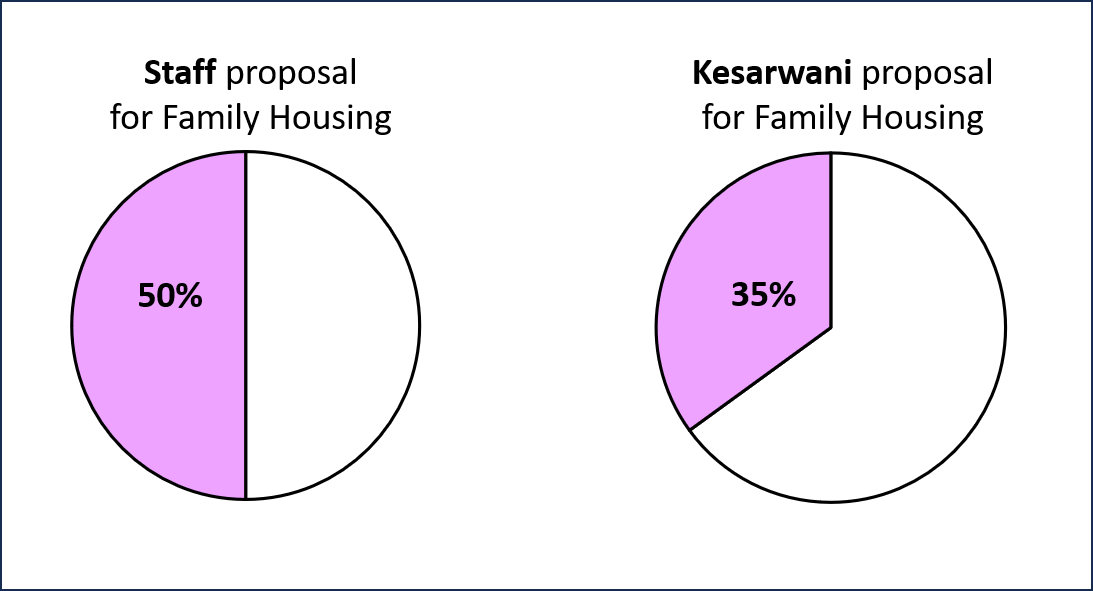
At least 50% of the units be either two or three bedrooms. Note that there is no affordability requirement for this last option.
Councilmember Kesarwani proposed amendments that reduced the number of affordable units required by:
Changing the rental affordability requirement so that none of the units had to be for people earning less than 60% ($87,900 for a family of 3) of the AMI, and
Reducing to 50% the number of units required to be rented at levels affordable for 80% of the AMI ($117,200 for a family of 3), and
Requiring the rest (50%) be affordable to those earning 120% of the AMI ($175,800 for a family of 3).
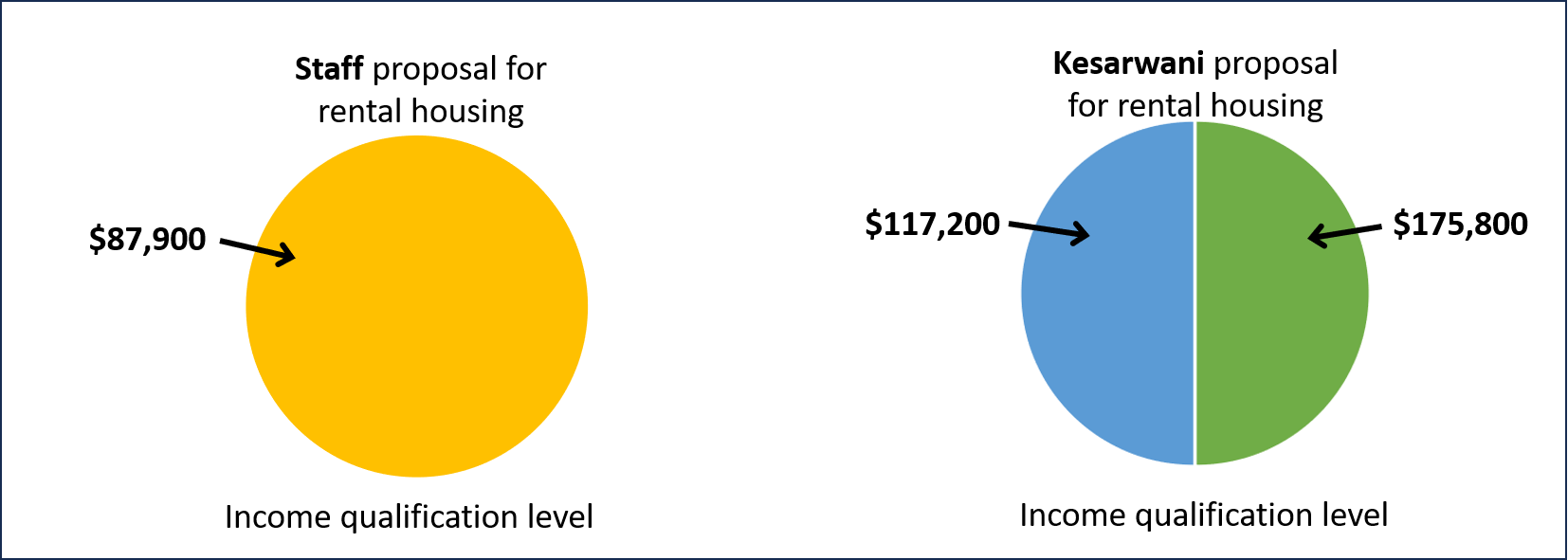
Perversely, Kesarwani removed the option of providing affordable “for sale” units as a way of meeting the requirement for an Affordable and Family Housing Opportunity Area, ensuring that no affordable condos would be built in the newly rezoned areas.
Staff explained that they thought the 50% requirement for “family housing” (2 or 3 bedrooms) in option 3 was feasible, but according to Kesarwani, “50%... just felt like a very high number of units”, and proposed that the number be decreased to 20%” (later increased to 35%).
So, there you have it. Councilmember Kesarwani took a proposal that would have:
Created a building where a family of 3 with an income of less than $88K could afford to rent, and changed it so that half the units are considered affordable if the family of 3 earns up to $176K;
Provided opportunities for a condominium purchase where a family of 3 with an income of less than $117K could afford to buy a unit, and changed it so that the condominiums have no provision for affordability;
Created a building where 50% of the units would be suitable for at least small families, and decreased that amount to 35% of the units.
This was topped off with a trademark tirade by Councilmember Kesarwani, where she exclaims “People sleep in their cars. They sleep in these encampments that we had people give public comment about. So, I saw a sign back there that says ‘Delay the Plan.’ We waited 11 years to get homes on San Pablo Avenue!”
It should be noted that the homes being planned by the SPASP will not be for those people sleeping in their cars or in encampments. And as far as the new homes housing “people living on the edge, who are at risk of getting evicted, risk of becoming homeless, risk of getting displaced”— the plan that councilmember Kesarwani and the council approved is much less likely to help these people than the plan suggested by staff.
By increasing the height limit to 7 stories for buildings on San Pablo Avenue, council made it easy to avoid building on-site affordable housing in them, because developers will not have to use the state density bonus laws to get to the economic “sweet spot”. By weakening the provisions for the Affordable and Family Housing Opportunity Areas, the new homes will contain no rental units affordable for very low-income families, no possibility for buying a condo at below market rate, and fewer apartments suitable for families.
Councilmember Kesarwani stated during her final comments that “I fully respect differences of opinion”. As an example, listen to the end of her histrionic rant, where she declares “I am the one who sits on the dais and gets to make the vote and decision tonight!”